

My Daughters Were Born With No Lungs. Here's What That Did to My Capacity for Joy
What forty years and four undeveloped lungs have taught me

Last night, on the eve of my 40th birthday, I stood in my kitchen with tears streaming down my face while I watched my daughters blow balloons a quarter of the way up.
A decade ago, I welcomed my 30s while grieving the loss of the life I had thought I would live—a relationship I thought was forever, an identity built on other people’s opinions of success and beauty. I was oblivious to who I was and what I wanted, and so I went out with lanterns looking for myself. I took voice lessons and drank champagne on Friday nights with my closest friends. I took my branding agency work seriously and waited tables until I could sustain myself with just my business. I read a lot of books and wrote, and wrote, and wrote. And I made the choices that led me into motherhood.
People always say they could never have imagined the life they are living now. But I was so fragile on my 30th birthday that if someone had told me what I would endure before my 33rd birthday, I wouldn’t have survived the story, let alone the reality of birthing dead daughters into the world and holding my breath for seven and a half months before I allowed myself to believe they were really back from the dead.
Most people don’t change much, but profound and devastating or unexpected life changes can force people to transform. Enduring the death and resurrection of my daughters, the years of medical complexity, the long wait for a son, and the loneliness of feeling disproportionately responsible for it all shaved away a lot of my ego and delusion. Now, at 40, I am holding an unglamorous life and a gritty identity. It’s unlike anything I journaled about in 2016, but I am decidedly more myself than anyone else I’ve ever been.
I thought prematurity would kill my daughters; I thought heartache would kill me. Here we are six and a half years later, reading Little House in the Big Woods and anticipating ice cream cake.
In the daily grind of medical motherhood, I learned about short bowel syndrome, and high myopia, and a dozen other diagnoses. But most importantly, I learned how capable I am of learning anything. In the psychologists’ office, I learned that all along I had been off-the-charts analytical, with high foresight, and exceptional memory. I just hadn’t trusted myself to believe it—or use it.
And because I also learned in the psychologists’ office that I have a tendency to minimize my weaknesses (Are there people who don’t do this? LMK in the comments), I must confess that I have walked through life with sweeping blind swaths. I have (and now must actively fight against) a compulsion to believe people’s words and see people’s potential instead of their behavior. In jobs and in relationships, when I get fucked over, instead of taking it at face value, I prefer to argue people into better behavior. It has never worked.
I also have terrible visual spatial awareness.
I turn 40 today with a perspective on myself and on life that could not have existed without having been dragged through the hell that is this life.
Last December, I took my daughters to their pulmonologist. Their x-rays were incredible for a couple of fetuses born with underdeveloped air sacs stuck together like never-inflated balloons.
When babies are born with underdeveloped lungs (or, in our case, with basically no lungs), they are given surfactant—a chemical compound that reduces surface tension between two liquids, or between a liquid and a gas, or between a liquid and a solid. In periviable babies like mine, the surfactant works to keep their alveoli from sticking together, which would prevent any of the mechanically provided oxygen from getting to them.
This is how my daughters started their lives: surfactant and a hundred high-pressure bursts of oxygen pumped into their lungs by a machine every minute.
Lungs that start working before their time develop on their own time and in their own way. Our way included several trips to the ED for respiratory distress and a week-long hospitalization for pneumonia.
And so, pulmonology continues to follow the girls’ lungs, until the lungs prove they don’t need to be watched so closely. I was hoping that after my daughters’ 6th birthday last December, their pulmonologist would discharge us. I had looked at the x-rays on our health portal in advance of the visit. As someone with the audacity to operate completely out of her depth, I saw the films and deemed them as close to normal as we were going to get, considering where we came from. In defense of my audacity, I have to tell you, the doctor told me their x-rays do look great, but they’d still have to come back again after their 7th birthday because they failed spirometry.
I thought for sure with those pretty x-rays, two summers of aggressive swimming, and finally being able to blow out their birthday candles that we’d pass the blow test. They blew and blew into the oval shaped mouth piece, but the display gave us a suboptimal number every time. Their brains still struggle to coordinate with their lungs.
The big inhalation and the forceful exhalation with which we blow out birthday candles is a feat of physiology that most of us take for granted.
After seven and a half months in neonatal intensive care—after a two year wait for my son and after realizing I will never share the burden of parenting the way I want to—my transformation came in the form of a shift in my expectations.
I cannot unsee everything that can go wrong in the building of a body and a brain. I’m not surprised that health fails, that people disappoint, that children wake up at five o’clock on the morning of your 40th birthday and sabotage your workout. And it still hurts. I just stopped expecting it not to.
I have often heard people say they couldn’t imagine what I’ve been through—that they don’t know how I survived it. It wasn’t resilience alone that sustained me. I had to stop expecting the lungs to be normal.
I suspect my joy is bigger than other people’s because I consider all the shitty ways it could go, and I expect one of those. So when something unfolds in the way of textbook child development, I delight in it. I experience tear-inducing joy from the milestones most people expect will happen. If you didn’t cry the first time your kid took a breath without a ventilator doing it for them, we are not the same.
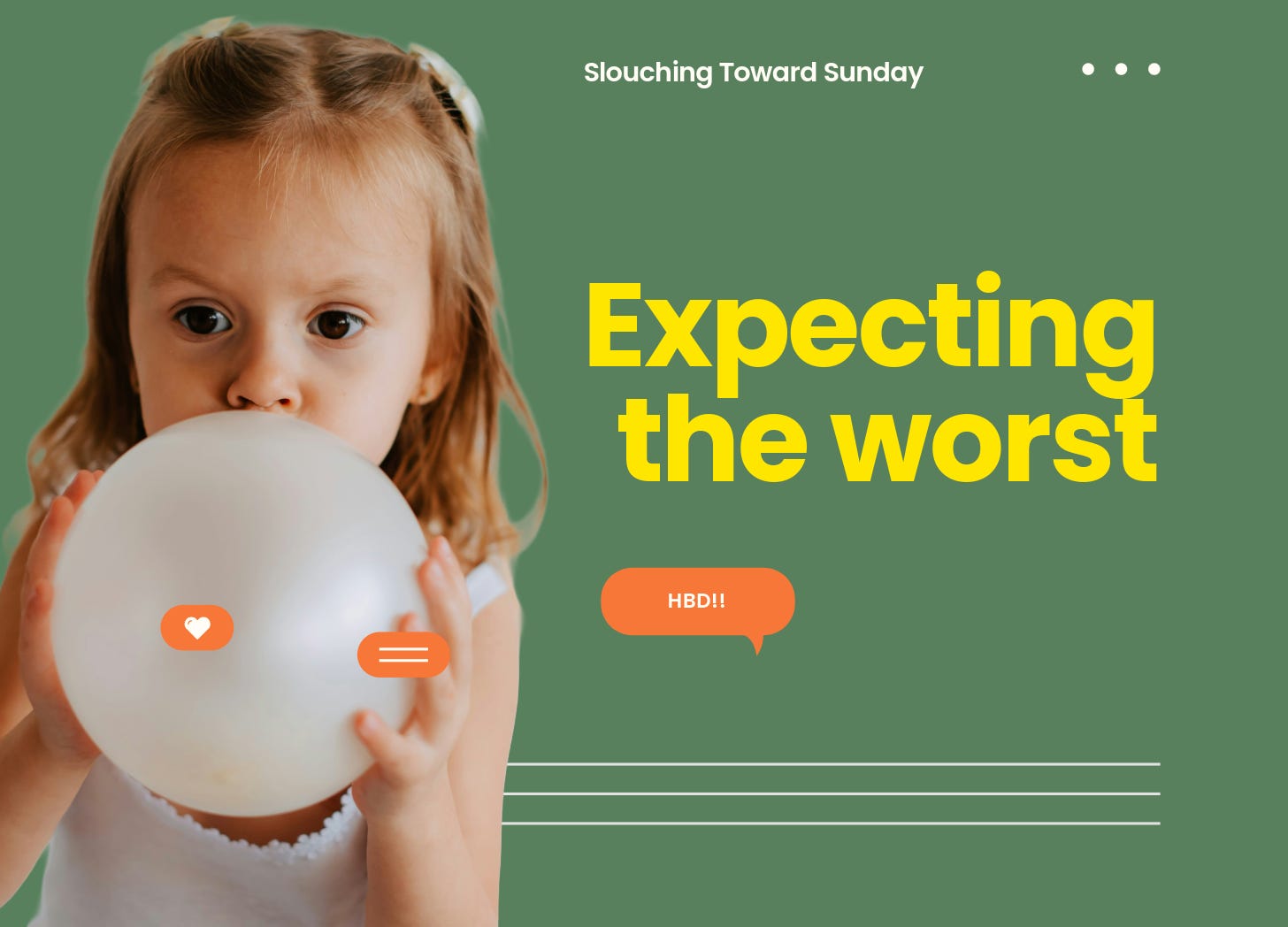
When my daughters came to me last night with balloons in their mouths saying, “mom, mom, watch this,” I did not expect their balloons to stretch and fill with air, but they did. And I let tears of joy stream down my face. Despite a sabotaged workout and three kids who have been up since 5am, I cannot imagine a better 40th birthday gift than two little girls born with no lungs teaching their two year old brother to blow up balloons while simultaneously warning him to keep the balloon out of his mouth because it is (their words) a choking hazard.
Excellent writing!! Thank you for continuing to share your very special and complicated life.
Tears as I read this. Cheers to a new decade of becoming you, my friend.